Children’s Poetry Books I’m Reading and Recommending

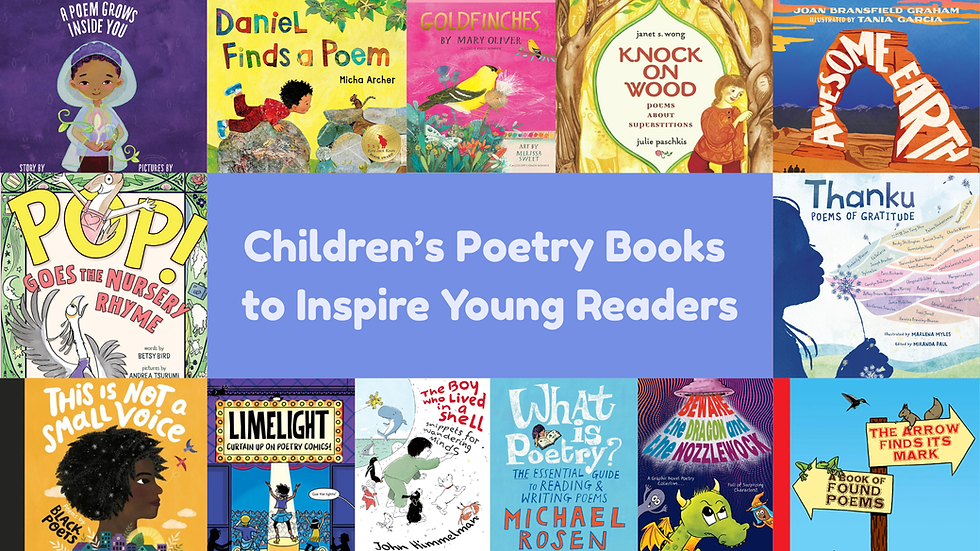
Earlier this month I wrote about different ways you can celebrate National Poetry Month with kids. This April I’m celebrating National Poetry Month by reading widely in contemporary children’s poetry. In this post I’ll be sharing some of the stand-out books that I’ve enjoyed thus far.
Below, I’ve grouped the books into a few categories that I hope will be helpful for teachers, librarians, or parents so you can quickly find what might work best for your young readers/poets!
Poetry Picture Books
A Poem Grows Inside You –– Katey Howes, illustrated by Heather Brockman Lee
In this rhyming picture book, Katey Howes uses the relatable metaphor of a growing plant to show how a poem takes root, sprouts, and spreads its message. It’s an inspiring book about nurturing self-expression, one that speaks to the joys, doubts, and fruits of the creative life. Heather Brockman Lee’s dazzling illustrations will make you want to linger on each page.
Great for: classroom read-alouds, introductions to poetry and/or metaphor
Daniel Finds a Poem –– Micha Archer
This picture book follows Daniel as he asks animals around the park what poetry means to them. It’s a profound book about observing the world around us and finding beauty in unexpected places. Archer’s awe-inspiring collage illustrations will get kids eager to go exploring outside for poems of their own!
Great for: classroom read-alouds, introductions to poetry, learning about nature and the five senses, nature poem activities (see my Nature Walk scavenger hunt idea here)
Goldfinches –– Mary Oliver, illustrated by Melissa Sweet
Melissa Sweet’s stunning mixed-media collage artwork transforms a classic Mary Oliver poem into a naturalist’s notebook. This book would pair wonderfully with Daniel Finds a Poem, as both offer inspiration and guidance for observing the natural world with care and wonder. I also highly recommend checking out the other children's poetry books that Melissa Sweet has illustrated, including How to Write a Poem by Kwame Alexander and Deanna Nikaido and Dear Acorn (Love, Oak): Letter Poems to Friends by Joyce Sidman.
Great for: birdwatching activities, nature poem activities
Pop! Goes the Nursery Rhyme –– Betsy Bird, illustrated by Andrea Tsurumi
This picture book offers a hilarious spin on classic nursery rhymes, with a chipper weasel who just won’t stop popping up in all the wrong rhymes! It’s a joy to read this one aloud, especially for parents and educators who are tired of reciting the same old rhymes again and again. Andrea Tsurumi’s exuberant illustrations do a wonderful job of highlighting the weasel’s silly, anarchic energy.
Great for: classroom read-alouds, nursery rhyme lessons
Poetry Collections
Awesome Earth: Concrete Poems Celebrate Caves, Canyons, and Other Fascinating Landforms –– Joan Bransfield Graham, illustrated by Tania García
This groundbreaking book of concrete poems takes its inspiration from the intriguing geological features that shape our landscapes. It could easily fit into a teacher’s poetry unit or earth science unit. Either way, it’s a book that will inspire young readers to see the natural world with fresh eyes. Check out sample poems here.
Great for: introductions to concrete poetry/shape poems, poetry/STEM crossover lessons on geology and geography
Knock on Wood: Poems about Superstitions –– Janet S. Wong, illustrated by Julie Paschkis
This collection of poems offers playful and surprising takes on well-known superstitions, inviting readers to wonder where superstitions come from, what they mean, and why we invent them. Julie Paschkis’ surreal and mesmerizing illustrations add wonderful layers to these fun poems. I also highly recommend checking out their collaboration Night Garden: Poems from the World of Dreams, one of my favorite children’s poetry collections!
Great for: classroom read-alouds, opening up discussions about family and cultural traditions
The Boy Who Lived in a Shell: Snippets for Wandering Minds –– John Himmelman
This whimsical collection of poem-stories is brimming with imagination. Each poem is a micro-fable or a mini-portrait of a strange character—some hilarious, some wistful, all sparkling with poetry magic. It’s a book that’s difficult to classify, and that (to me) is just one of its many charms. You can listen to an NPR interview with author/illustrator John Himmelman here.
Great for: fans of Shel Silverstein and Chris Harris, bedtime read-alouds, creative writing activities about inventing fun characters
Themed Poetry Anthologies
Thanku: Poems of Gratitude –– edited by Miranda Paul, illustrated by Marlena Myles
This anthology published by the nonprofit We Need Diverse Books features tender poems on a wide variety of subjects, all united by appreciation for family, the natural world, and often overlooked things. Each poem is written in a different poetic form, making this a great resource for educators hoping to show students the many forms a poem can take. Vibrant illustrations by Marlena Myles provide a beautiful through line between the different subjects. Check out Naomi Shihab Nye’s “Dear Sky,” one of my favorites from the anthology, here.
Great for: SEL discussions, lessons on poetic forms
The Arrow Finds Its Mark: A Book of Found Poems –– edited by Georgia Heard, illustrated by Antoine Guilloppé
This is an anthology of found poems that invites young readers to look upon the world with the eyes of a poet. The poets selected here find poems in places as various as signs, crossword puzzle clues, gardening catalogues, and book titles on a shelf. You’ll find plenty of well-known children’s poets here, including Charles Waters, Jane Yolen, J. Patrick Lewis, and more.
Great for: poetry scavenger hunts, lessons on poetic forms
This Is Not a Small Voice: Poems by Black Poets –– selected by Traci N. Todd, illustrated by Jade Orlando
This visually stunning anthology features over 100 poems by Black poets from across the diaspora, including canonical poets (Langston Hughes, Lucille Clifton, and more), beloved children's writers (such as Eloise Greenfield and John Agard), and today’s trailblazing poets (Eve L. Ewing, Renée Watson, and too many excellent poets to name here!). The book is thematically rich and diverse, allowing readers to read cover to cover or jump between poems. I’ve enjoyed re-encountering old favorites (such as this powerful poem by Ross Gay) and discovering new writers whose work I’m eager to explore more.
Great for: classroom read-alouds, lessons highlighting Black identity and resilience, lessons centered on poetic voice and speaking out against injustice
Poetry Comics
Beware the Dragon and the Nozzlewock: A Graphic Novel Poetry Collection Full of Surprising Characters –– Vikram Madan
I thoroughly enjoyed this hilarious and inventive collection of poetry comics. Vikram Madan creates a zany cast of characters each appearing in poems of their own, then many of them reappear later in surprising new ways. You’ll meet Stan the Slouching Man™, dinsosaurs called “Squishosaurs,” and a mysterious creature called the Nozzlewock, just to name a few. Check out this blog post about the making of these unconventional poem-comics. I highly recommend this book!
Great for: fans of Shel Silverstein and Jack Prelutsky, fans of graphic novels, reluctant poetry readers
Limelight: Curtain Up on Poetry Comics! –– Renée M. LaTulippe, illustrated by Chuck Gonzales
This innovative poetry graphic novel gives voice to a theater as it goes from auditions to rehearsals to opening night. The comics feature a wide variety of theatrical personae and poetic forms (triolet, pantoum, concrete poetry, mirror poems, and many more). It’s bursting with thespian energy and will hook graphic novel readers on poetry!
Great for: fans of theater and musicals, fans of graphic novels, classroom introduction to poetic forms
Poetry Handbook
What Is Poetry? The Essential Guide to Reading & Writing Poems –– Michael Rosen, illustrated by Jill Calder
Winner of the 2026 Hans Christian Andersen Award, author of classic children’s books such as We’re Going on a Bear Hunt, and YouTube poetry legend, Michael Rosen is surely one of the modern masters of children’s poetry. Which is why I was delighted to discover that he’d written this insightful handbook for young poets. He takes on the challenging question “What is poetry?” by highlighting many of the mind-bending and heart-opening things that poems DO, illustrating these points with examples from classic poems and his own wonderful oeuvre. This is a book I wish I’d had when I was starting to write poems!
Great for: young writers seeking hands-on advice and teachers seeking to better understand how to make poetry relatable and fun for kids
How You Might Use These Books
Here are just a few ways that educators and parents might share the aforementioned books with young readers, but of course, it’s totally up to you and your kids/students how you’d like to celebrate and explore poetry!
Read One Poem a Day: Any of the collections or anthologies mentioned above would be a great starting point for a daily reading ritual with your kids/students: one poem at the start or end of the day. Simply reading the poem aloud and enjoying the experience is enough!
Poems as Writing Springboards: If you'd like to go beyond reading the poems, you could invite kids to write a response poem to each poem you read, perhaps in a similar form or style or perhaps from a different perspective. You could even start a daily poetry journal full of response poems or reflections on the poems you read together.
Model Close Reading: You might use each poem as an opportunity to practice deep reading. That is, pay attention to any surprising word choices, reflect on any compelling figurative language, and/or consider why the poet might have chosen the poem’s particular form. Ask open-ended questions like "How does this line make you feel?" or "Why do you think the poet chose this word instead of another?"
Pair Poetry with Art: Consider asking each student to illustrate one line of a poem, then piece together the illustrations in order to show the class’ visual interpretation of the poem line by line. Alternatively, you might ask students to choose a favorite poem from an anthology/collection and make their own illustrated zine version of the poem.
If you’d like more ideas on how to celebrate National Poetry Month with kids, check out my post here.
Thank you for reading! You can find some of my poems for kids here on my website or here on YouTube. If you’d like to support the blog, consider ordering a zine, buying me a coffee, or signing up for my newsletter.
Happy reading!

Comments