Creative Challenges (and Other Challenges)


January is a challenging month. The days are short and cold, the nights are long and colder, and the extra hours of darkness provide ample time for basking in the grim glow of my handy-dandy despair device. And needless to say, this particular January was a doozy.
Knowing how it goes, I decided to take on a handful of reading and writing challenges this month. In fact, I heaped myself with challenges, as I wanted to leave little wiggle room for gloom. My intention was to build momentum for the new year, connect with the writing community, and introduce creativity and play into my daily routine. Below I’ll share some reflections on what I learned.
The month’s challenges included:
StoryStorm — a daily picture book idea writing challenge focused on generating new story concepts
StoryStudy — a daily picture book reading challenge centered on craft and close reading
Poem-a-day — a personal writing practice to stay connected to poetry each day
Monthly Poetry Book Challenge — a year-long challenge to read one (adult) poetry collection a month
StoryStorm
This was my second year completing StoryStorm. StoryStorm is an annual, month-long writing challenge created by picture book author Tara Lazar in which participants commit to generating 30 picture book ideas in 31 days. Throughout the month a host of guest writers share blog posts offering creative inspiration and encouragement. It’s an amazing community-building and idea-generating frenzy.
I was able to end the month with over 30 new story ideas. Granted, the word “idea” is a tad generous. Some days I managed to come up with just a silly-sounding title or a quirky character. It all counts, as the point is building up a body of ideas that I can return to and refine later. Even if none of these ideas materialize into full-fledged stories, I appreciated having the chance to write alongside so many talented kid lit creators and share in the hopeful enthusiasm of creative people writing to make a better, more welcoming world.

StoryStorm comes just once a year, but the blog posts are always available if you’re in need of a creative boost! I highly recommend checking them out.
StoryStudy
Inspired by StoryStorm, I came up with my own parallel picture book reading challenge. I called it StoryStudy, and the goal was simple: read 30 picture books in 31 days. I hoped that doing so would provide a daily dose of inspiration while broadening my knowledge of recent picture books. Each day I read at least one PB and shared a micro-review on X/Twitter and Bluesky, where I was grateful to be joined by author-illustrator Marty Lapointe-Malchik in completing the challenge. Below you can see the books that I read.
The benefit of reading so many picture books back-to-back is that it reminds you how many different ways there are to tell a story. For example, Felicita Sala’s Bored uses the main character’s restlessness as a departure point for whimsy and endless surrealistic possibility. Cristina Sitja Rubio and Cristóbal León’s Strange Creatures adopts the collective voice of forest creatures dispossessed of their homes, imagining what reconciliation between the human and natural world might look like from a perspective that doesn’t center the human interlopers. Meanwhile, Calvin Alexander Ramsey and R. Gregory Christie’s book The Library in the Woods mines the history of American segregation and finds a symbol of Black resilience in a library that opens up new worlds for the main character and his family.
In short, each picture book I read offered a chance to reflect on the many possible avenues into storytelling. Some stories might start with a silly situation, others with a unique perspective or a memory that unfolds into deeper meaning.
This challenge ultimately reaffirmed why I love picture books so much and why I think adults should read them regularly. They are tiny windows into wonder and brief reminders of why empathy matters. They model for us adults how we might open ourselves to possibility and—like Eleanor in Emily Winfield Martin’s book The Wildest Thing—let the wild in.
Poem-a-Day
I periodically take on Poem-a-Day challenges when I want to reconnect with my love of poetry. I say Poem-a-Day but this challenge might be more accurately described as Poem-Idea-a-Day, somewhat modeled on StoryStorm’s notion of generating launchpads for future writing.
There were some days where all I could muster up was a haiku, like the one I scribbled for the weekly #HaikuSaturday Bluesky writing chat on the morning the US invaded Venezuela:
It hurts. We write to
find peace only to find peace
kidnapped overnight.
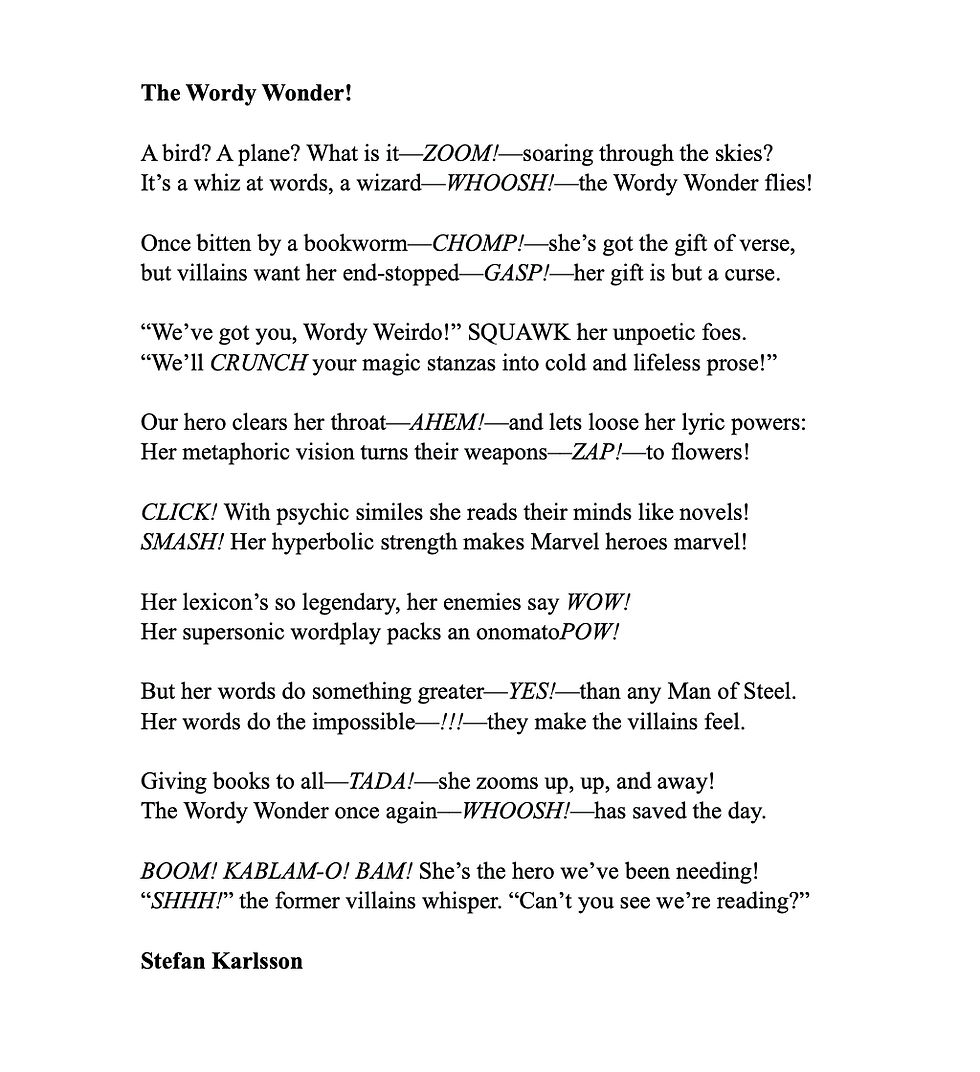
Other days I was able to spend more time developing a complete poem draft. One of these poems (a superhero poem for kids called “The Wordy Wonder!”) was even featured on Brian Moses’ wonderful children’s poetry blog as part of a series inspired by the UK’s National Year of Reading.
What I love most about doing Poem-a-Day is that it makes me more receptive on a daily basis. I wake up and immediately I’m searching for a possible poem. As a result, I’m more attuned to my surroundings and less inclined to judge or react. My eyes stay open—my heart, too.
Monthly Poetry Book Challenge
January kicked off my year-long poetry reading challenge. I’m aiming to read one poetry collection (for adults) each month in order to slow down and spend more time engaging with one poet’s voice and vision. This month’s poet was Antonio Machado, and I read the collection Times Alone (1983) with poems selected and translated by Robert Bly.
Machado’s poems proved surprisingly stabilizing in these turbulent times. His appreciation for nature, his distaste for navel-gazing, and his political conscience struck me as helpful guides for our historical moment. He writes, “The eye you see is not / an eye because you see it; / it is an eye because it sees you.” He is a poet who invites us to direct our gaze outward and consider why we must look beyond ourselves in the first place: to wake up and engage with our neighbors.
I’m excited to keep this poetry reading challenge going, and I’m hoping to read more contemporary poets in the coming months. More updates soon.
Takeaways
It’s probably not realistic to take on this many challenges every month, but as a reset/jumpstart to the new year, I found it very helpful. Having these challenges helped me stick to a daily routine and stay motivated even when things felt bleak personally, nationally, and globally. If I could just complete my daily reading and writing, I felt enriched—and that sense of inner enrichment (hopefully) spilled over into my interactions with others.
Obviously, I’m a big fan of creative and/or reading challenges, and I think that month-long challenges are a good timespan. Week-long challenges rarely have enough heft for me to keep committed, whereas the thought of a year-long challenge fills me with dread. A month is doable. (For those with more endurance, consider The Stafford Challenge.)
The challenges encouraged me to prioritize daydreaming over doomscrolling, to go outside and "touch grass," and to meet up with other creative people. When I’m on the lookout for inspiration, I’m more open to new experiences. Though this January was in many ways a horrific month, I found that it was nonetheless packed with small joys: meeting up with local writer friends, listening to Emily Winfield Martin share her new book, meeting a yeti (my fondness for yetis is canon), writing a poem on Ursula K. Le Guin's typewriter, dropping off zines and notebooks at one of my new favorite bookstores, dancing to one of my favorite techno producers at a local club, talking about books at the Kids at Heart Book Club night, attending a family-friendly march for immigrant justice, and celebrating my rabbit Jean-Pierre’s 12th birthday (that’s 80+ in bunny years!).
This month of many challenges was dedicated to generating lots of new ideas, but at the same time, I found myself taking solace in the good things and good people around me. On that note, I’ll end with these words from Antonio Machado:
You say nothing is created new?
Don’t worry about it, with the mud
of the earth, make a cup
from which your brother can drink.


Comments