The Making of a Children’s Poetry Zine


It started with a shared love of playful poems—the kind that make kids laugh and look at the world differently. My friend Carl Burkitt and I joined forces to create a project that celebrates the imagination and seeks creative possibility (and play!) in every nook and cranny of the universe.
After months of writing, chatting, laughing, drawing, and dreaming, we’ve completed Chatting Poems, a children’s poetry zine brimming with joyous jabber and everyday wonders.
In this post, I’ll take you behind the scenes and show how we dreamed up our zine’s concept, how we chatted our dreams into existence, and how you can join the chat.
A Friendly Chat Over Tea
I’d long been an admirer of Carl’s work and we’d tweeted back and forth a few times, but what launched us into collaboration was a poem written by Carl’s teacup. That is, Carl posted a poem on X/Twitter written on a cafe napkin from the perspective of his teacup. I was inspired by the whimsy of that idea and wrote back to Carl—from the perspective of the tea inside his teacup.
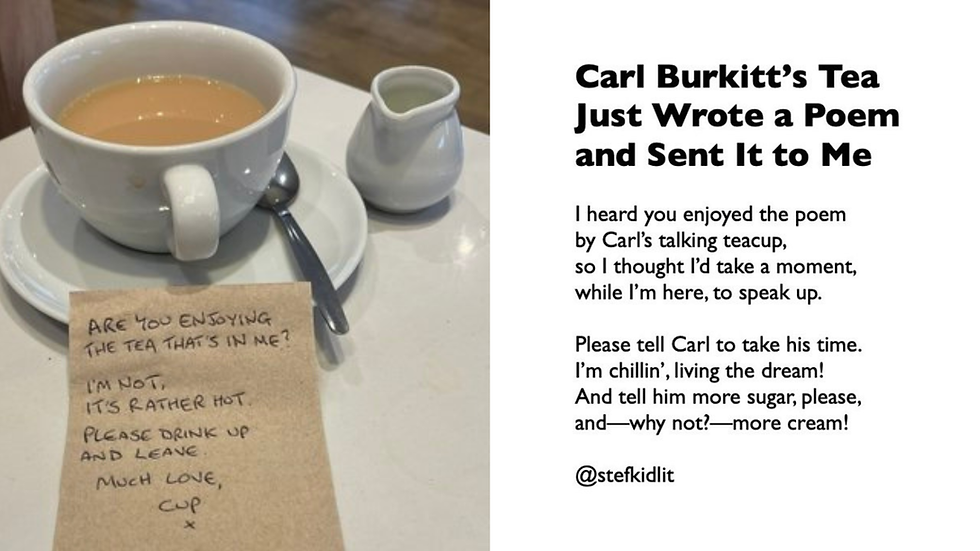
After our brief exchange over tea, the wonderful children’s poet Jennifer Thomas noticed our shared affinity for zany kid lit poems and suggested a collaboration. Jennifer graciously shared with us her own experience collaborating on a children’s poetry zine called Invisible Things with fellow kid lit creators Susan Andrews, Jerrold Connors, and Laura Cooney. (This zine is wonderful and highly recommended, by the way.)
And so our poem chat began! Carl and I started talking and immediately we adopted conversation in all its varied forms as the theme of our zine.
After all, in a conversation there is a place for everything: sharing, agreement (or disagreement), understanding (or misunderstanding), learning, and growing. In a conversation we discover ourselves through connecting with others and shaping our own voices. In a conversation we make private dreams a shared reality.
One Poem Turns to the Other and Says...
For seven months Carl and I wrote to each other in a frenzy of exuberant chatter. This was a long-distance chat: Carl lives in Manchester, England, and I live in Portland, USA, but if you listened closely, you might have heard the frantic pitter-patter of two buddies busily typing poems back and forth across the globe.
Together we developed a framework for our collaboration: I’d send Carl a writing prompt and he’d send one back, we’d respond to each other’s prompts with poems, and next we’d reply to each other’s poems with new poems. Then repeat. In this way, we created an interwoven chain of prompts and poems that kept the conversation going.
One of the fun challenges of our project was trying to surprise each other. Anyone who follows Carl on X/Twitter knows that he is a master of creating compelling writing prompts. For example, Carl would surprise me with a prompt like: imagine something inside of a whale. Then I’d have the challenge of trying to surprise him with my response.
In this case, I thought a fish or even a sailor seemed too obvious, but what if the whale was a “wishing whale” and the poem’s speaker was a penny trapped in the whale’s belly? We pushed each other to think outside of the box (or in this case, inside of a whale).
Writing these voice-driven poems, I was reminded of the poet Frank O’Hara’s ideal of writing poems that feel as personal as a conversation between friends over the phone. I felt that same exhilaration of chatting with a good friend while responding to Carl’s prompts and poems, and I think that sense of freedom comes across in the varied forms that our poems take—including sonnets, lists, emails, reveries, riddles, manifestos, acrostics, concrete poems, and more.
In total we wrote over 50 poems together, but for the sake of creating a digestible zine, we narrowed our selection down to 36 poems. It was tough to cut some beloved characters (sorry DJ Wormy-Worm and Grumpy Graham Grass!) but these cuts ensured that our zine didn’t become a whopping tome.
The next step was bringing these characters to life on the page.
The Illustration & Zine Design (Or How I Became a Children's Illustrator)
In May 2024 I started a YouTube channel where I illustrated and read my own poems for kids. I made the illustrations by first drawing the outline of a character on paper then digitally coloring in the drawing with my own original hand-marbled papers.
This YouTube venture was concurrent with but independent from our zine project. That said, Carl saw my artwork and suggested that this colorful illustration style could work well for our zine project. And so, just like that, I became an illustrator and started sketching characters for each of the poems we’d selected.
It was a unique challenge and a joy to bring characters like Carl’s Mark the Martian to life. I wanted the illustrations to reflect the playfulness and energy of the poems, so I aimed for a cartoonish style with bright colors.

I gained a lot of valuable illustration experience from this exercise. Since starting this project, I’ve even had my illustration work published in a literary magazine (Issue 9 of Little Thoughts Press) and I’ve been interviewed by Lit Kids Magazine about my artwork.
After completing the illustrations, the next step was assembling the zine. I had to brush up on Adobe InDesign, which I’d learned thanks to my time as a literary magazine editor at UCLA and UC Irvine, but building a document from scratch was new to me. Again I tried to approach the page layout with the same spirit of play as the poems themselves, and I hope this makes for a joyful reading experience.
Zines Must Be Made by All, Not by One
Maybe it’s silly to invest so much energy into a project as ephemeral as a zine, but even if that’s the case, I recommend it—especially if you can collaborate with a friend. Creating a zine from concept to printed page is a liberating experience: there are no rules, no editors who must be pleased, and no creative limits except those you set for yourselves. Not to mention, there is something profoundly satisfying about holding a project in your hands that you made without anyone’s permission.
Carl and I set ourselves this creative challenge and we completed it out of sheer joy and why-notness. Together we wrote poems that I doubt we ever would have written on our own, and we got to know each other better in the process.
One of the many things I came to admire about Carl is his generosity of spirit—a perspective that fuels the endless inventiveness of his poems. His poem “Meeting a Lump of Clay” (included in the zine) perfectly demonstrates this as its speaker, a sculptor’s lump of clay, cheerfully transforms from “a tiny railway” into an “ice cream sundae” and even “the beak of a beautiful bluejay.” Thanks to Carl’s light touch, the lump of clay finds ever-renewed hope in its limitless transformations and concludes that “being clay / is a wonderful way to spend your days.”
Taking my cue from Carl’s lump of clay, I can confirm that collaborating on a zine—with all the creative play and conversation that goes into it—is indeed a wonderful way to spend your days.
Join the Chat!

Our zine is now out in the world and available for purchase both in physical and digital form (see the links below).
We hope you’ll pick up a copy and meet the characters we dreamed up together. Most of all, we hope this project will inspire young people to imagine their own characters and poems!
We’d love to see your declarations for (or against) the “Banana Manifesto.” We’re all ears for musical instruments who want to join the “ding ding ding” of Carl’s violin string. We (secretly) await your spy messages encoded in silly acrostics.
Write to us on social media with your own poem responses and let’s keep the conversation going!
Find my socials here:
Instagram: @nautiluspaper
X/Twitter: @stefkidlit
Bluesky: @stefankarlsson.bsky.social
YouTube: @StefanKidsPoetry
Find Carl's socials here:


Comments